

Tier 3 · Build the Table · Lesson 3 of 8
Choosing your two inks
You pick two inks before you have played a single card, and for the rest of that deck's life they decide which problems you are allowed to solve. Choose badly and no card in the deck fixes it, because the fix is in an ink you did not pick.
The rules name the six, then stop
A Constructed deck is capped at two inks.
In the Constructed format, each player's deck must contain at least 60 cards, can't contain more than two ink types, can't contain more than 4 cards with the same full name, and can't contain any banned cards.
Comprehensive Rules 1.10.1.1
In plain terms: sixty cards or more, two inks at most, four copies of a full name at most, nothing banned.
The six inks are Amber, Amethyst, Emerald, Ruby, Sapphire and Steel (5.2.5). That is the last thing the rules ever tell you about them. Search all 507 and none says what Amber does or what Steel is for.
So every claim you have heard about what an ink "is" describes what has been printed, not what is legal. That can be counted instead of argued about.
Counted from our card database on 9 August 2026, every card once per name, dual-ink cards left out. Each ink holds roughly 390 cards, so the gaps below are real and not one ink being bigger.
What each ink actually gives you
Amber protects and sings. Bodyguard on 28 characters, Support on 23, Singer on 23, and not one printed with Evasive, Rush, Ward, Challenger or Resist. Lowest average strength of the six, nearly the highest willpower: hard to knock over, bad at knocking anything over. Five cards in the whole ink can banish, damage or return an opposing character.
Amethyst draws and delays. 61 cards that draw, more than any ink, and 31 that exert an opposing character. When it deals with something it usually returns it to its owner's hand instead of banishing it. Evasive on 38, Rush on 22, Challenger on 21.
Emerald quests hard and takes things away. The most characters worth 3 or more lore (33) and the lowest average willpower, so it scores fast and it is banished easily. Evasive on 39, Ward on 24, and 51 cards that answer an opposing character.
Ruby hits. Highest average strength, lowest average lore, only 11 characters at 3 lore or more. Rush on 28, Reckless on 18. It readies characters again (32 cards) and drains lore outright (29 cards). It draws the fewest cards of any ink: 18.
Sapphire pays for things. 60 cards that put extra cards into your inkwell and 42 that look at the top of your deck, both far beyond every other ink, plus the most items (48). Most inkable ink, at 81%. It has 8 answers to an opposing character.
Steel removes. 68 cards that answer an opposing character, 52 of them by dealing damage to a chosen target. The only ink with Resist printed on characters, 30 of them, though other inks can grant it. Bodyguard on 25, Challenger on 16, highest average willpower and cost in the game.
Pick the second one to cover the first
A deck needs three things that lucky draws cannot supply: a way to remove a character it cannot beat in a challenge, a way to keep drawing cards, and a way to pay for what it draws. Your two inks either cover those between them or they do not.
The first is where decks break, because it is the most unevenly spread thing in the game.
Card draw is spread far more gently: Amethyst 61, Steel 47, Emerald 38, Amber 30, Sapphire 23, Ruby 18. Paying for cards is barely spread at all. Sapphire has 60 cards that grow your inkwell and no other ink has more than 6, which is why it keeps turning up as somebody's second ink.
So the method is short. Take the ink you want to build, find its worst of those three numbers, and let that pick the second ink.
One card can spend both slots
Some cards carry two ink symbols instead of one.
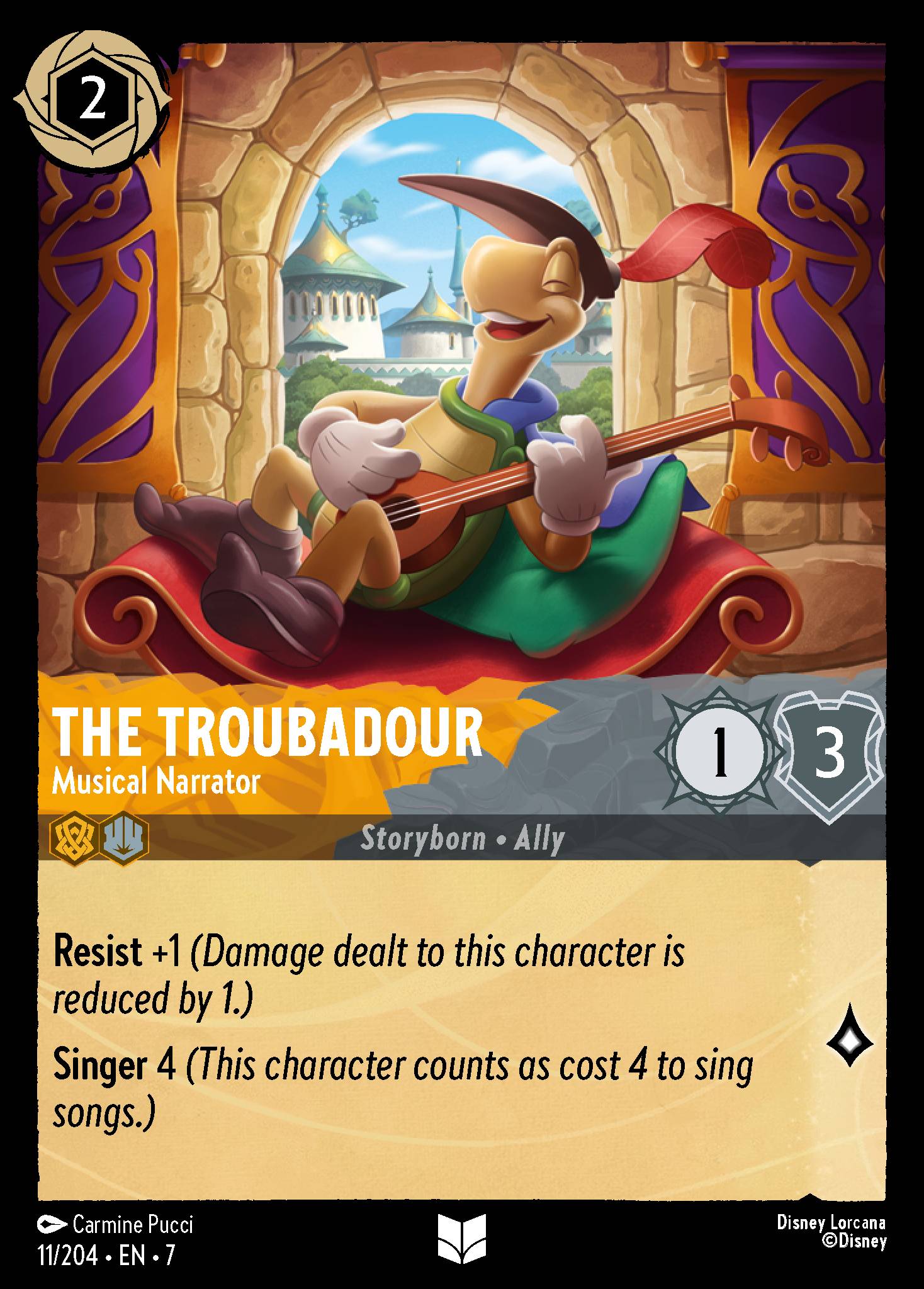 The Troubadour - Musical NarratorAmber-Steel · 2 ink · 1/3 · 1 lore · inkable
Some cards have more than one ink type. Cards with two ink types have two ink type symbols and count as each ink type.
Comprehensive Rules 5.2.5.1
In plain terms: a card with two symbols is fully both of those inks at once, never half of either.
That card is Amber and Steel, so one copy makes your deck Amber and Steel, and both slots are spent. There are 136 dual-ink cards, and each is available to exactly one of the fifteen pairs.
Amber and Amethyst are the gentlest pair for a new player, and between them they hold 24 cards that can answer an opposing character. Emerald and Steel hold 119.
When that deck meets a character it cannot out-muscle, the problem is not that you failed to draw your answer. It is that there was almost nothing to draw.
Your first ink is Ruby. Which of its three numbers should choose your second ink?
- Its answers, at 31. 31 is already comfortably enough. Reinforcing the number that is fine is how you end up with two inks doing one job.
- Its card draw, at 18, the lowest of the six inks. Right. Ruby can already remove things. What it cannot do alone is keep a hand, so it wants a partner that draws.
- Its inkwell growth, at 4. Only Sapphire grows an inkwell, 60 cards against 6 or fewer everywhere else. A number that is low in five inks out of six cannot tell you which one to add.
The honest part
Amber and Sapphire together hold 13 answers, the emptiest of the fifteen pairs, and people win real games with it. That is not a contradiction. A deck that scores more lore each turn than its opponent can take away never needs to answer anything, it needs the game to finish first. A missing tool is only a weakness if you were going to reach for it.
Two limits on the counts above. They cover the whole card pool, not whatever format you are building for, and a smaller pool can delete most of any one of them. And they count cards, not quality: five answers where one is excellent beat sixty that are merely fine. Counting tells you where to look, not what to play.
- A Constructed deck uses at most two of the six inks.
- No rule says what an ink does. The printed cards do.
- Choose your second ink to cover your first ink's worst number.
- A dual-ink card is both inks and spends both slots.
- Having no answers is fine if you win first.
Pick the ink you like most. Write down its three numbers from this lesson, answers, draw and inkwell growth, circle the smallest, and name the one ink that best fixes it. That pair is what you carry into the next lesson.
Rules quoted from the Disney Lorcana Comprehensive Rules, version 2.2.0, effective 9 July 2026. Card counts taken from our own card database on 9 August 2026, and they will drift as new sets are printed. We cite rule numbers because they change between versions.
Next: The curve. Your two inks decide what your deck can do, and the curve decides when it can do it.
No account needed. Sign in and your progress follows you anywhere.