

Tier 4 · Play the Table · Lesson 6 of 8
Playing around what you cannot see
Somebody will tell you to play around removal. Nobody tells you what that actually means in a game where your opponent cannot do a single thing while it is your turn. It means something much narrower than holding your best card back, and much more useful.
Playing around is sequencing, not defence
The instinct arrives from other card games: you commit, they answer you in the same breath, so you wait. Lorcana does not have that moment. While it is your turn, your opponent cannot play a card, cannot use an activated ability, cannot quest and cannot challenge.
Cards can normally be played only from a player's hand. Only the active player can play a card during their turn.
Comprehensive Rules 4.3.2
In plain terms: every action belongs to whoever is currently taking their turn (4.1.2). Lorcana has no priority system, so there is no window for them to answer you in. The one thing that can happen on your turn is a triggered ability from a card they already have in play, and that card is sitting face up where you can read it.
Which means nothing you play is ever at risk during your turn. It is at risk from the moment you pass. So waiting does not protect anything. It only moves the same exposure one turn later, and you pay for the delay in lore and board position that you do not get back.
What genuinely changes the result is not whether you play the card. It is which card you expose, and in what order. That is the whole skill. Everything below is how to work out the order.
Turn the unknown into a list of three cards
"What might they have" is an unanswerable question and it will paralyse you. Replace it with a list you can actually build, using three filters in this order.
- Can they pay for it? Their ink readies in full at the start of their turn (3.2.1.1) and you may count any inkwell at any time (7.5.4). Inkwell size, plus one if they ink again, is the hard ceiling on their next turn. Anything priced above that line is not a card yet. It is a card in two turns.
- Is it even in their deck? Colour is a boundary, and it is a tight one.
- Would it actually beat you? The one people skip. Of the cards left, most are merely unpleasant. Keep only the ones that change who wins.
In the Constructed format, each player's deck must contain at least 60 cards, can't contain more than two ink types, can't contain more than 4 cards with the same full name, and can't contain any banned cards.
Comprehensive Rules 1.10.1.1
In plain terms: once you have seen both of their colours, the entire universe of things they can ever do to you comes from those two, and no more than four copies of any one card. Limited is the exception, where a deck may contain any number of ink types (1.10.1.2), so this filter is worth much less in a draft.
Run all three filters and the fog usually collapses into two or three specific cards. That is a list you can play against. "They might have something" is not.
Play around the card that beats you, not the card that hurts you
You cannot dodge everything at once, so the ranking matters more than the list. These two do not cost the same, and the gap between them is often the entire decision:
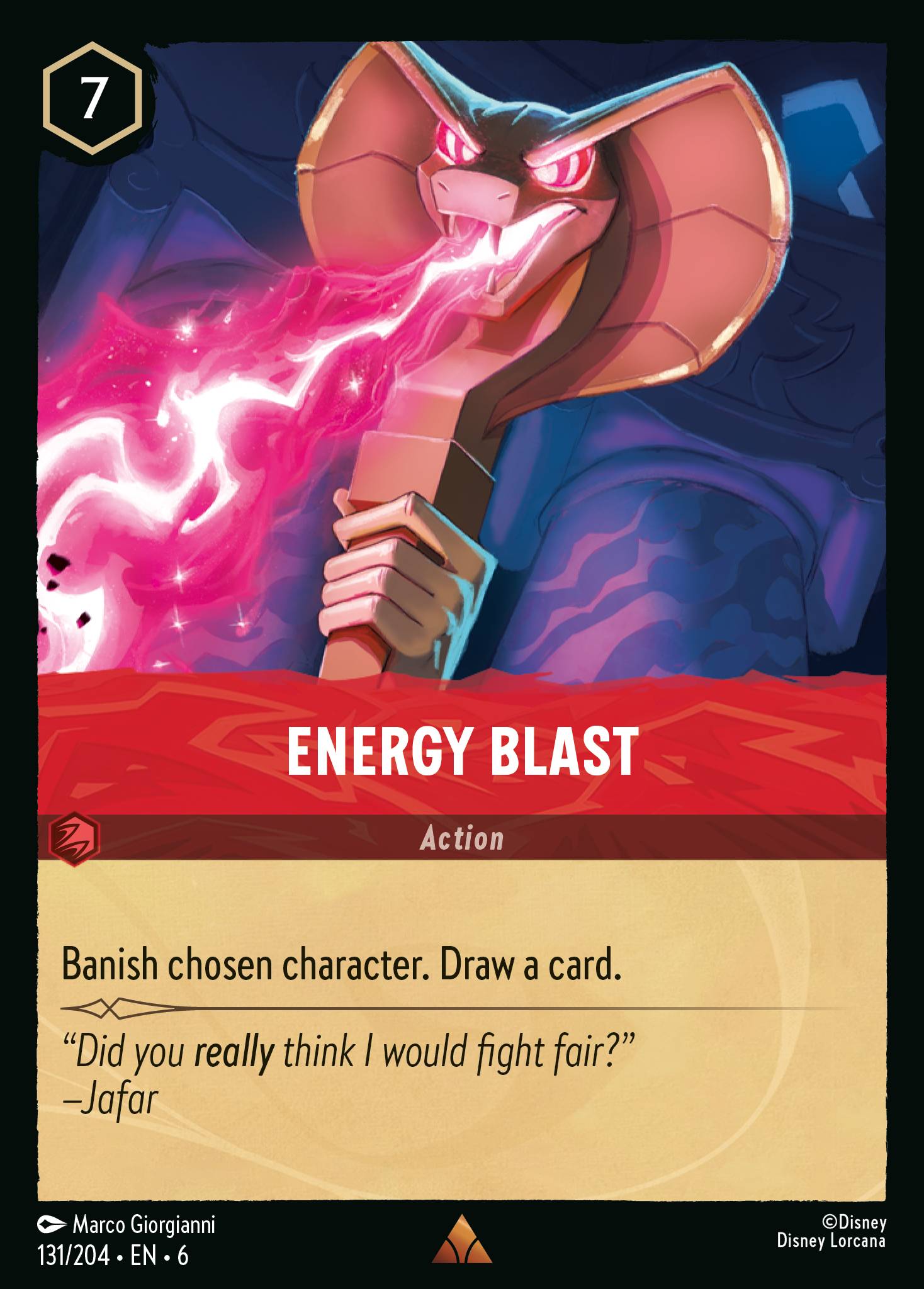 Energy BlastRuby · 7 ink · Action · uninkable
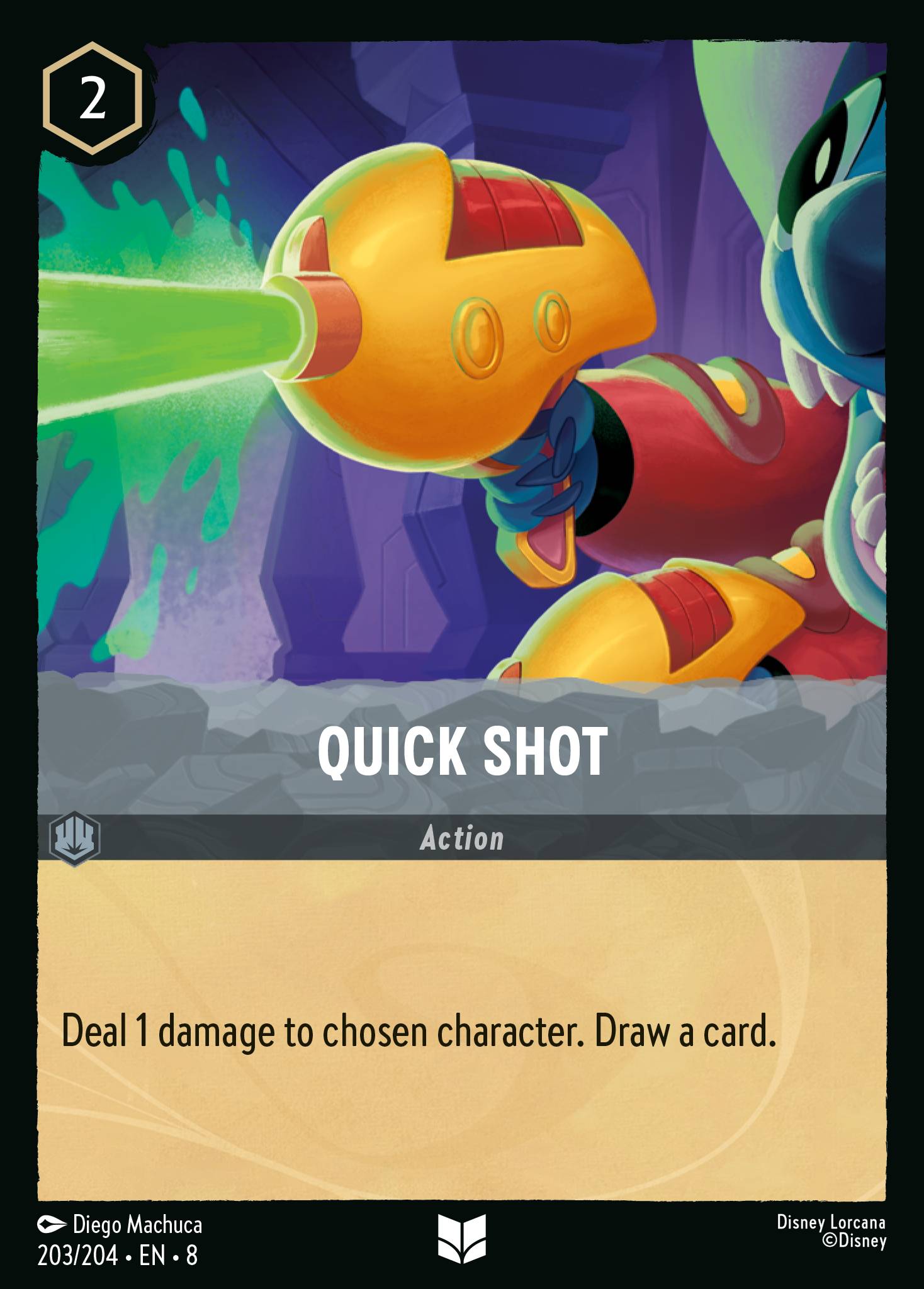 Quick ShotSteel · 2 ink · Action · uninkable
One banishes your character outright. One deals damage to it. If you are ahead and racing, the cheap damage is annoying and the banish is the card that actually takes the game from you, so you sequence against the banish and you accept the damage. If you are behind and your only path back is one large character surviving two turns, the ranking can flip entirely.
The ranking is never a property of the card. It is a property of your position. Ask what you are actually protecting: usually it is the plan, not the card.
A worked board
Turn six. You are two lore ahead. They have five cards in their inkwell, four in hand, and have shown Ruby and Steel. Your hand holds the best character in your deck and two ordinary ones.
Filter one: five plus one is six, so nothing above six exists next turn. Filter two: Ruby and Steel, and you know what those colours do. Filter three: of the affordable Ruby and Steel cards that a real deck plays, one banishes and a couple deal damage. Your list is short.
Now the wrong conclusion, which is the popular one: hold the best character forever. Holding it forever is how you lose a game you were two lore ahead in, and it hands them the turns they needed.
The right move is the order. Play the two ordinary characters. You have made a board that has to be answered while keeping the card you cannot replace in hand for one more turn. If the banish exists, it gets spent on a character you were happy to lose, and now you know. If it does not, you found that out for the price of one turn and your best character lands into a board where it is not the only thing worth pointing at.
That is playing around a card while still using your turn. Compare it with the passive version, where you play nothing, keep three cards in hand and give away two lore. Same fear, one of them wins games.
Playing around a card they cannot pay for. The most common one by a distance. If it costs five and they will have three, that card does not exist on this turn. Count before you worry.
Playing around everything at once. No single turn dodges a banish, a board-wide damage effect and a discard. Trying to do all three produces a turn that does nothing at all.
Treating a read as knowledge. The filters tell you what is possible, never what is in their hand. Four cards and six ink may be four characters and no answer whatsoever.
You have worked out that your opponent could banish your best character on their next turn. What does "playing around it" mean here?
- Keep the character in hand until the threat has passed. This is the version that loses games. The threat does not pass, because their ink comes back every turn and they draw more cards. You have not avoided the exposure, you have delayed it and paid lore for the delay.
- Play the character anyway, since they cannot respond during your turn. True and irrelevant. They cannot act while it is your turn (4.3.2), but you are about to hand them the turn, and the character is exposed from that moment. "No interruptions" changes when the risk starts, not whether it exists.
- Play something else first that they would want to spend the answer on. Right. You cannot stop the card, so you choose what it hits. Present a target you are content to lose, and either the answer gets used on the cheaper character or you learn it was never there. Both outcomes are worth a turn.
Where this advice is wrong
The cost of playing around something is immediate and certain. The card you fear is a maybe. The lore you did not gain is not a maybe. Trade real turns for hypothetical cards often enough and you will lose games to an opponent who never held the card at all.
The filters are also close to worthless in the first few turns against a deck you do not know. You have seen one colour or none, their ceiling is low enough that most things are unaffordable anyway, and the strongest play is very often just your strongest play. Filtering takes time too, and in a timed round, doing it every turn is time you may want later.
And the honest limit: none of this is knowledge. It narrows a guess. A player who is never once punished by a card they failed to play around is not reading well, they are playing too carefully to win.
- Nobody can act during your turn, so waiting protects nothing.
- Their inkwell plus one caps what they can afford.
- Two ink types cap what their deck contains.
- Rank threats by what beats you, not what hurts.
- Playing around means choosing the target, not withholding.
Once, before you commit your best card, name out loud the single card you are afraid of. Then check it against the three filters: can they pay for it, is it in one of their two colours, and does it actually beat you. If it fails any one of them, play your card.
Once per game. Not every turn.
Rules quoted from the Disney Lorcana Comprehensive Rules, version 2.2.0, effective 9 July 2026. We check every rules claim on this site against the current document rather than quoting from memory, because rule numbers change between versions.
Next: Read this board. It puts eight real boards in front of you and asks for your read before it shows you the reasoning.
No account needed. Sign in and your progress follows you anywhere.