

Tier 2 · Learn the Table · Lesson 6 of 11
Songs and singing
This is the rule most players have wrong, including people who have played for a year and people who post decklists online. If you take one rules lesson from this course, take this one.
The mistake
Ask around and you will hear some version of this:
"Songs are for singers. You need a character with the Singer keyword to sing them."
That is wrong, and it is expensive. It leaves free cards sitting in hands all over the world.
What the rule actually says
A song is a type of action, and every song has a second price printed into the rules on top of its ink cost. That second price is one exerted character of the right size.
All songs allow the player to pay an alternate cost instead of their ink cost to play them. Being a song means "You may pay, 'exert a character with ink cost N or greater' to play this card instead of its ink cost," where N equals the ink cost of the song.
Comprehensive Rules 5.4.4.2
In plain terms, with the important part isolated:
Any character whose ink cost is equal to or greater than the song's cost can exert to sing it. For free. No keyword required.
You do not have to take my word for it either, because it is printed on every song card. Look at the reminder text on Poor Unfortunate Souls, a 2-cost song:
A character with cost 2 or more can exert to sing this song for free.
Reminder text, printed on the card
A character with cost 2 or more. Not "a Singer." Not "a character with the Singer keyword." Any character you have who cost 2 ink or more.
Every 2-cost song in the game can be sung by nearly every character on your board, on almost any turn after the early game. That is a free card, every turn, that most players never use.
Songs are not a niche archetype. They are a resource almost every deck can access.
Then what is Singer for?
Singer lets a small character sing a big song.
Singer N means "This character can exert to pay the alternate cost of a song card as though they had cost N instead of their normal ink cost."
Comprehensive Rules 8.11.1
In plain terms: the character pretends to be bigger than it is, but only while singing.
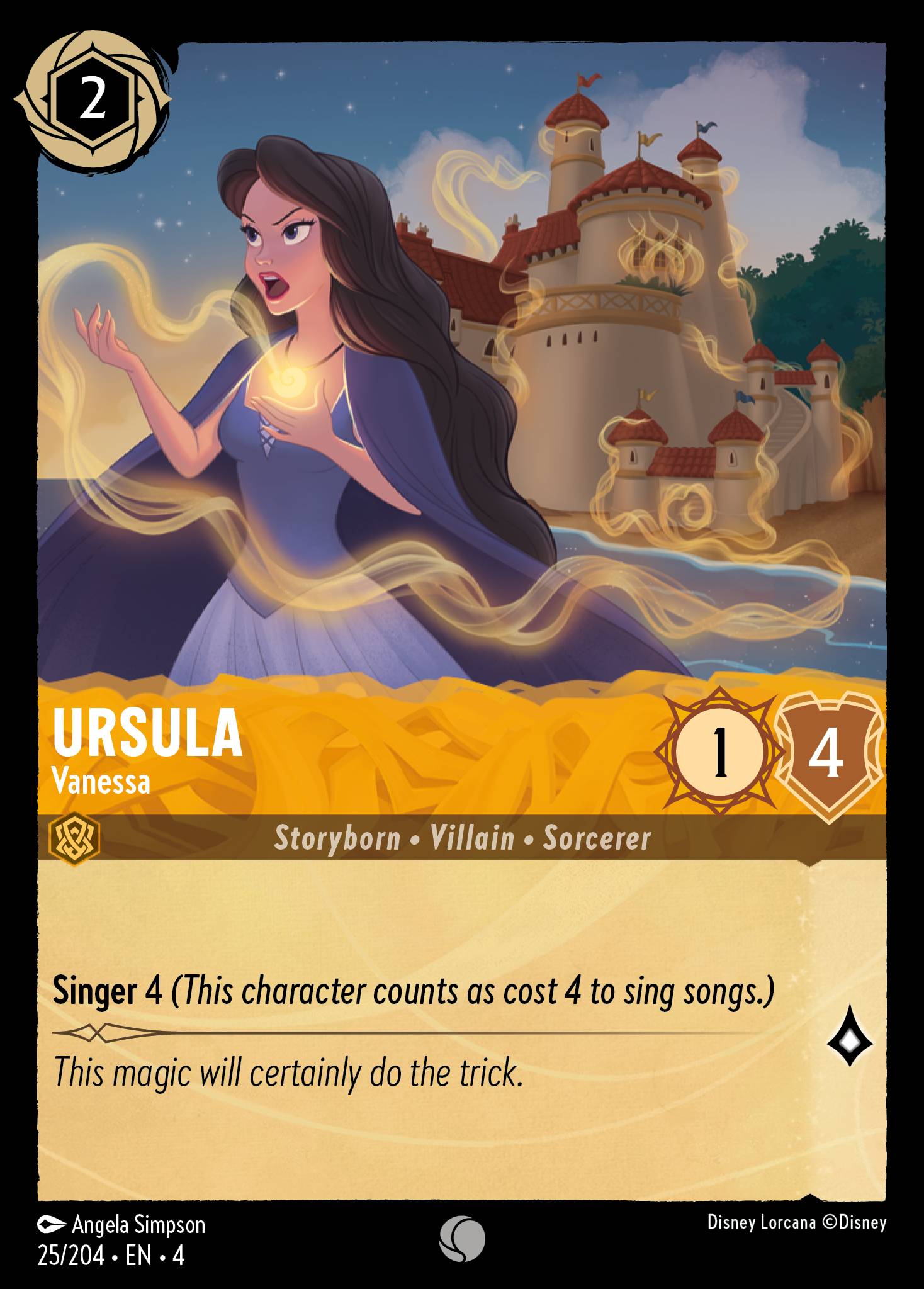 Ursula - VanessaAmber · 2 ink · 1/4 · 1 lore · inkable
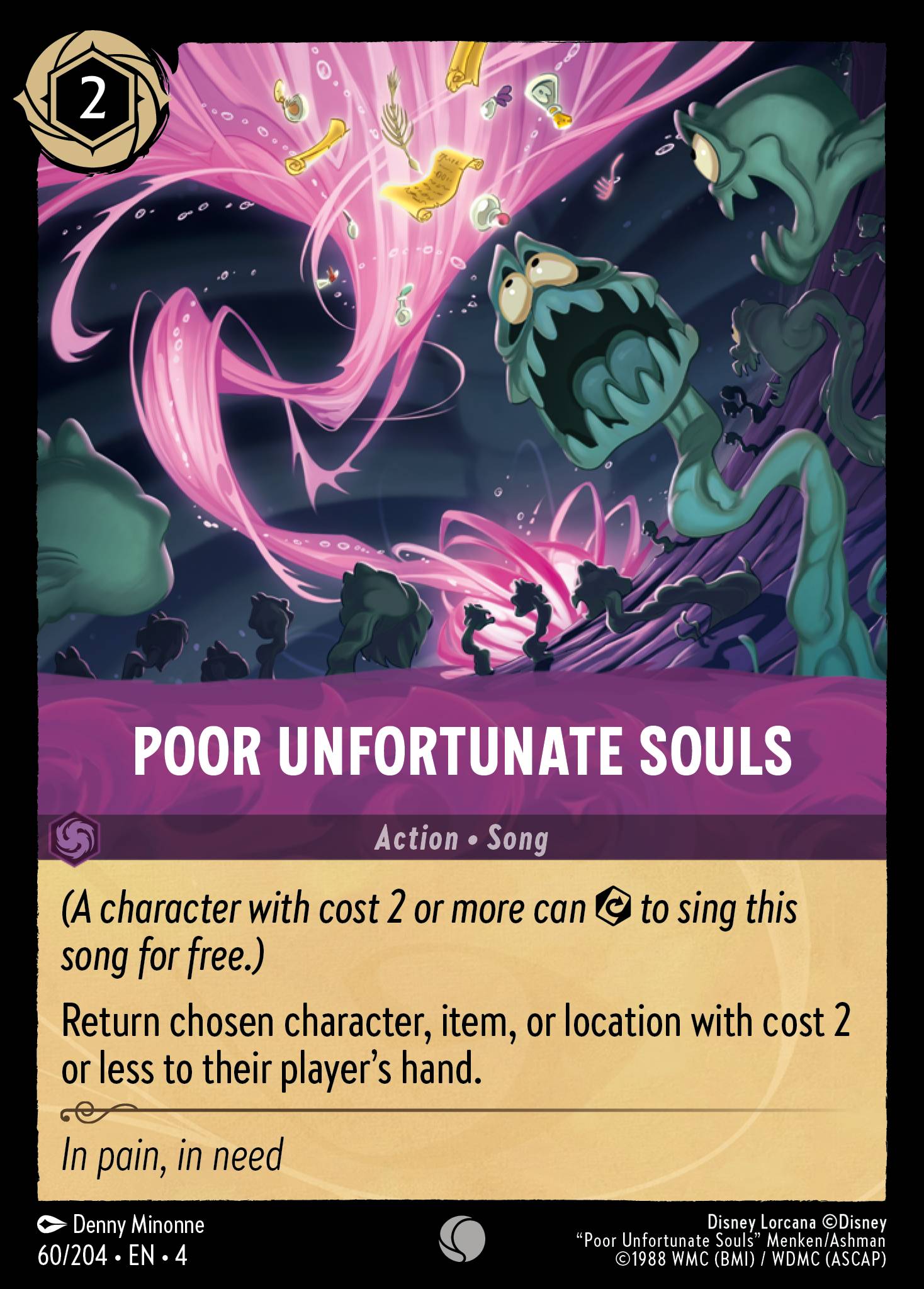 Poor Unfortunate SoulsAmethyst · 2 ink · Action · inkable
Take Ursula - Vanessa above. She costs 2 ink and has Singer 4.
- Without Singer, a 2-cost character could sing songs costing 2 or less.
- With Singer 4, she sings songs costing 4 or less, while still only costing you 2 ink to put down.
So she can exert to play something like Lost in the Woods, a 4-cost song, for free, on a board where she was the cheapest thing you played.
Singer is a discount on which songs you can reach, not permission to sing at all.
It does not change the song's cost. The rules are explicit that effects like Singer do not change the ink cost of the card (4.3.5), and that the character counts as cost N only for singing (8.11.2). So a card that says "chosen character with cost 3 or less" still sees Ursula as a 2-cost character, not a 4-cost one.
It does not make the character bigger. Singer 7 on a 4-cost body is still a 4-cost body in a challenge. People misread this constantly.
You have a 3-cost character in play with no keywords at all, dry and ready. In your hand is a 2-cost song. Can you play the song for free?
- Yes. Exert the character and sing it. Correct. The only requirement is that the character's ink cost is equal to or greater than the song's. Three is greater than two, so it sings. No Singer keyword needed, and this is the single most valuable thing in this lesson.
- No. It has no Singer keyword. This is the myth. Singer lets a small character sing a big song. It is not permission to sing at all, which every character already has.
- No. The song costs 2 and the character costs 3, so they do not match. They do not need to match. The rule is "ink cost N or greater," where N is the song's cost. Bigger characters sing more songs, not fewer.
The limit everyone forgets
Singing means exerting, and exerting means the character has to be dry.
A character that entered play during their player's current turn is considered to be drying. A drying character can't quest, can't be declared as a challenging character, and can't exert.
Comprehensive Rules 5.1.1.11
So the classic beginner sequence of "play my singer, sing my song" does not work. The singer has to have survived a full turn cycle first. Plan a turn ahead or the card is stuck in your hand.
The flip side, which is genuinely useful: a character with Reckless can still sing (8.7.4). Reckless forces you to challenge if you can, but singing is not questing and it is not challenging, so a Reckless character with nothing to challenge is not a wasted card.
Sing Together
The other keyword, and the one that makes wide boards frightening.
Sing Together N means "You and your teammates may pay, 'exert a number of your characters with total ink cost N or greater' to play this card instead of its ink cost."
Comprehensive Rules 8.12.1
In plain terms: add costs together across several characters instead of needing one big one. Three 2-cost characters can sing a Sing Together 6 song between them.
One detail that decides games: the rules specify ready characters (8.12.2). You cannot contribute a character that is already exerted from questing. Sing first, then quest with whatever is left, never the other way around.
The real cost of singing
Nothing here is free in the way it looks. You are paying with a character's turn.
A character that sings did not quest. If that character was going to quest for 2 lore, then the song cost you 2 lore. The question is never "can I sing this," it is "is this song worth more to me than the lore that character would have brought back?"
Which is the question the rest of the course keeps asking in different clothes: what did that actually cost you?
- Any character can sing a song costing its ink cost or less.
- Singer N lets a small character reach a bigger song.
- Singer never changes the card's cost or the character's size.
- A drying character cannot sing. It must survive a turn.
- A character that sang did not quest. That is the price.
At the end of each of your turns, look for characters you exerted to quest and ask whether a song in your hand would have been worth more. Not to change the play you already made, just to build the habit of seeing songs as available.
Rules quoted from the Disney Lorcana Comprehensive Rules, version 2.2.0, effective 9 July 2026. Card text checked against the current card data. We cite rule numbers because they change between versions and a claim without one is a claim you have to take on faith.
Next: Items and locations. A song is a kind of action, so the card types left to meet are the two that stay on the table instead of going to the discard.
No account needed. Sign in and your progress follows you anywhere.