

Module 5 · Read the Table · Lesson 5 of 8
Ink as information
Every card you have ever put into your inkwell, you held up and showed your opponent first. That is not table manners, it is a required step. If you have been treating that facedown pile as private, you have been broadcasting all game on a channel you never thought to listen to.
The facedown card is not a secret
Inking feels private. You pick a card, it goes facedown, nobody turns it over again. But the privacy arrives one beat too late, because before the card goes facedown it has to be shown.
First, the player chooses and reveals a card from their hand with the inkwell symbol.
Comprehensive Rules 4.2.1.1
In plain terms: the reveal is not optional. It exists so all players can verify the inkwell symbol is really on the card (4.2.1.2), and the side effect is that your opponent learns one card that was in your hand.
What stays hidden is smaller than people think.
The inkwell is a private zone. Players can't look at a card in an inkwell at any time, even their own. Players can count the number of cards in any inkwell at any time.
Comprehensive Rules 7.5.4
In plain terms: the faces are hidden, the pile is not. Anyone may count any inkwell whenever they like, including yours, mid-turn, without asking.
The three things your inkwell says out loud
The count
Your ink total is a promise about your next turn. At six ink, a good opponent plays as though you hold your best six-cost card, because they have to. They cannot see your hand, but they can see the ceiling of it, and the ceiling is what they plan against.
The card
They watched it go in. That tells them the card is in your deck, so more copies may be coming, and that this copy is now ink and stays ink. It also tells them what you were willing to give up. Inking your answer to their best character says you did not expect to need it.
The turn you skip
Not inking is the loudest thing you can do. It says one of two things: your hand is full of cards without the inkwell symbol, or the card you would have inked is one you need this turn. Both are readable, and neither is a message you can take back.
What makes all of this pure signal is that the choice costs you nothing mechanically. Nothing on the front of an ink card affects the ink it makes (7.5.1). A Steel card and an Amber card are the same one ink. When two cards in hand are equally droppable, the only difference is what the reveal tells the other player.
Their inkwell is a receipt
This is the half almost nobody uses. A player readies their cards in play and in their inkwell at the start of their own turn (3.2.1.1). Nothing readies their ink on your turn, so while you play, their inkwell sits in exactly the state they left it.
The status of cards in an inkwell can't be hidden from other players.
Comprehensive Rules 7.5.4
In plain terms: exerted and ready are public. Barring a card that exerts ink as a cost, every exerted card is ink they spent last turn and every ready card is ink they could not use.
Your turn five. They show seven cards, five exerted and two ready. Their whole last turn cost five, and they sat on two ink they could not spend. That is hard to fake, because ink you do not spend does nothing until your next turn: turn actions happen in the active player's Main Phase (3.3.1, 4.4). Two idle ink usually means a hand that has run out of plays.
If you want proof the game treats the inkwell as public, look at the cards that read it. One compares ink counts across players, the other keys off the exerted status of a whole inkwell.
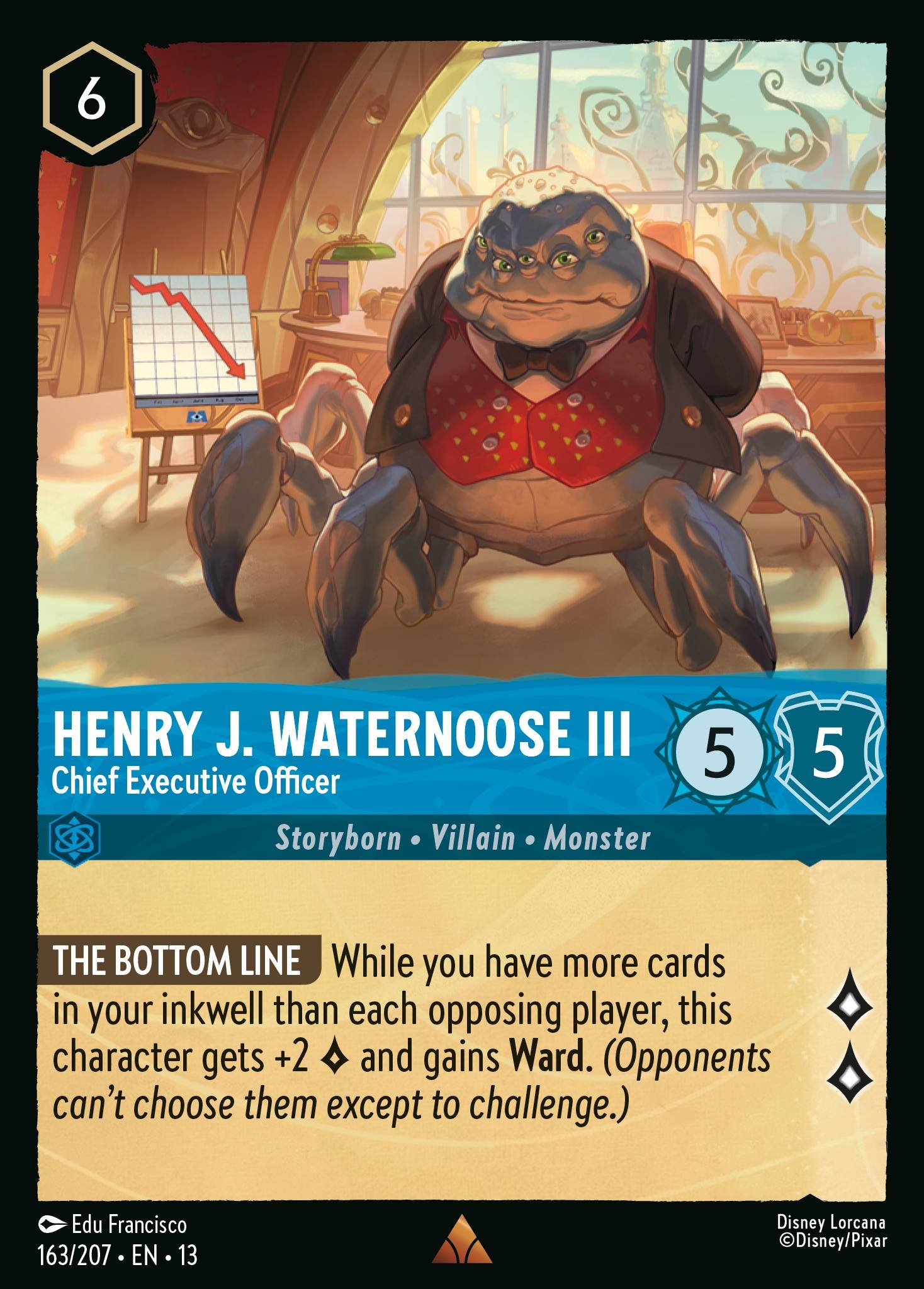 Henry J. Waternoose III - Chief Executive OfficerSapphire · 6 ink · 5/5 · 2 lore · uninkable
 Randall Boggs - Envious CoworkerRuby · 2 ink · 3/1 · 0 lore · inkable
How to lie with it
Four levers, in order of what they cost you.
- Ink the card that tells the story you want told. When two cards are equally fine to bury, bury the one whose reveal misleads. Show an answer to their big threat and a careful opponent holds that threat back, even though the copy they watched you ink is the one you no longer have. Free.
- Ink up to a number you cannot use. Going to six promises a six-cost play, so they keep an answer ready for a card you do not own. Costs a card from hand, which was usually the right ink drop anyway.
- Spend down to nothing. If your hand is dead, a marginal play that empties your ink stops your inkwell reading "dead hand" all through their turn. Genuinely expensive: you traded a real card for a false impression.
- Bury without a reveal. When an effect puts a card into your inkwell, it is not revealed and does not need the inkwell symbol (7.5.6, 4.2.3.2). The only way to empty your hand and give away nothing.
Lever four has a card, and it is why this ability reads stronger than it looks. She inks from hand, so the card can be an uninkable one, and your opponent watches a card leave without learning which.
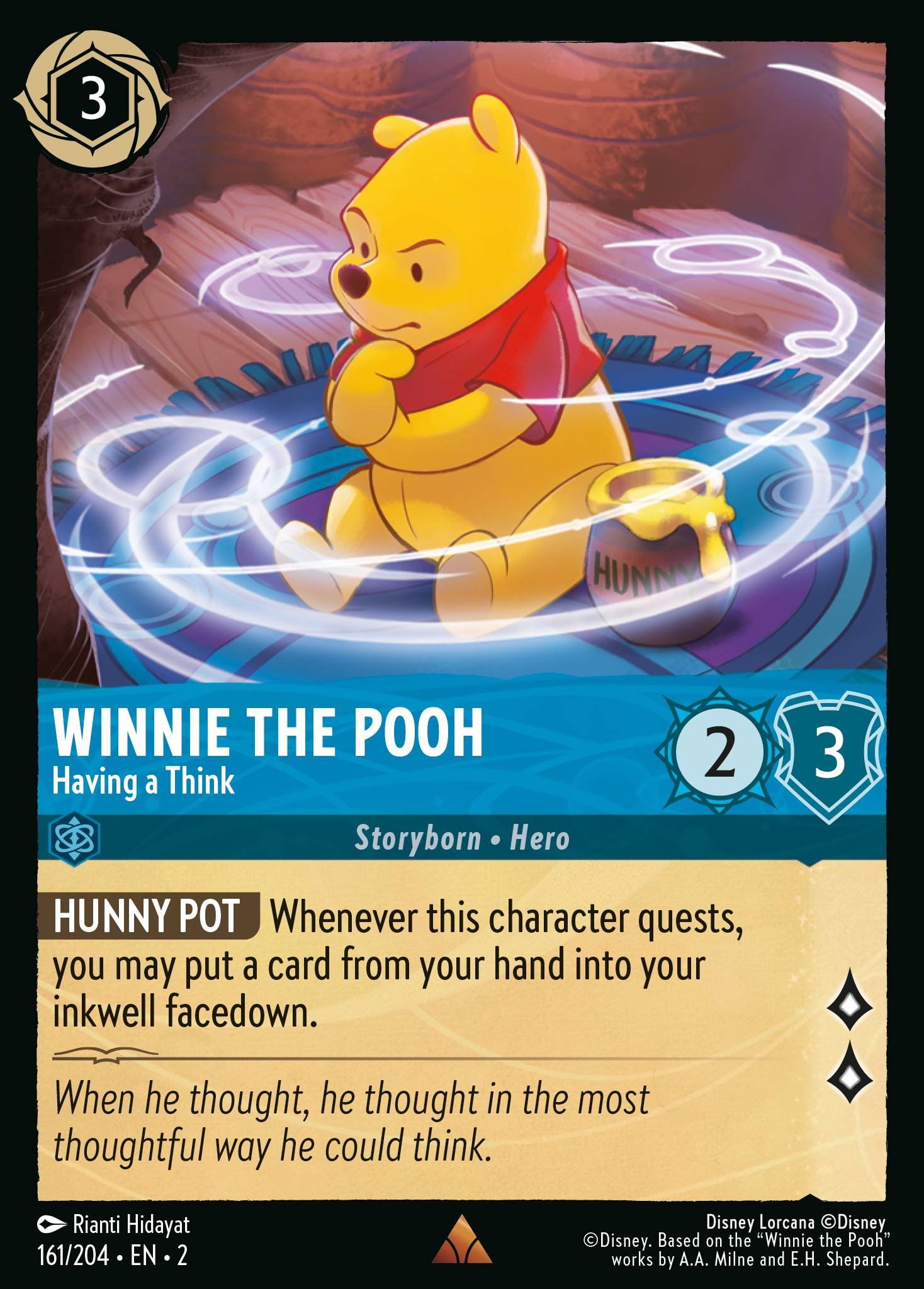 Winnie the Pooh - Having a ThinkSapphire · 3 ink · 2/3 · 2 lore · inkable
You cannot check your own. Rule 7.5.4 means even you may never look at an ink card again. Players bury the second copy of a key card on turn three, then on turn nine count their outs as though it were still in the deck. Your inkwell is not storage, it is a hole.
Paying real cards for a fake story. Every lie above except the first costs something. Against an opponent who never looks at your inkwell, you paid full price for a performance with no audience.
It is your turn. Your opponent's inkwell shows seven cards, five exerted and two ready. What does that most reliably tell you?
- Nothing. The inkwell is a private zone, so its state is hidden. Only the faces are hidden. You may count any inkwell at any time, and the status of the cards in it can't be hidden from other players (7.5.4).
- They held two ink back so they can react to whatever you do this turn. There is nothing to react with. Turn actions, including using an activated ability, happen in the active player's own Main Phase (3.3.1, 4.4), so ink left ready on your turn buys them nothing.
- They spent five ink last turn and could not use the other two. Right. Their ink readies at the start of their turn (3.2.1.1) and nothing readies it on yours, so you are reading a receipt for their last turn. Two ink they could not spend usually means a hand out of plays, which is the moment to push lore rather than play around an answer.
Where this edge is worth nothing
Most turns there is no choice to make. You hold one inkable card, or one obviously correct one, and the information game does not start until the decision is genuinely close. If the right ink drop and the clever ink drop disagree, take the right one. A bluff that costs you a turn of tempo has already lost more than it can win.
The reads are probabilities, not proofs. Two ready ink can mean a dead hand or a patient player holding a card on purpose. A skipped ink drop can mean a hand of uninkables, or a player who forgot. Every read here is one more weight on the scale, never the thing that decides the turn.
And the honest ranking: their board and the deck they are obviously playing tell you more than their inkwell ever will. This is a tiebreaker, and close games are the only ones that were ever in doubt.
- Every card you ink as your turn action is revealed first.
- Anyone may count any inkwell at any time.
- Exerted ink on your turn is last turn's receipt.
- Cards put in by an effect are never revealed.
- Skipping your ink drop is the loudest signal you send.
At the start of each of your turns, look at your opponent's inkwell once and say two numbers to yourself: how many cards, how many still ready. That is all. Do not change how you ink yet.
By the end of one game you will have spotted the turn their ink stopped moving. That is the turn their hand ran out.
Rules quoted from the Disney Lorcana Comprehensive Rules, version 2.2.0, effective 9 July 2026. We check every rules claim on this site against the current document rather than quoting from memory, because rule numbers change between versions.
Next: Thinking in game plans, not turns. Reading a player's ink only pays off if you are already thinking further ahead than the turn in front of you.
No account needed. Sign in and your progress follows you anywhere.