

Tier 2 · Learn the Table · Lesson 8 of 11
Damage versus damage counters
Two cards can leave the same two marks on the same character, and the game will treat them as completely different events. One of them is stopped cold by a keyword your opponent already has in play. The other walks straight past it.
The counters are identical. How they arrived is not.
There is only one kind of damage in Lorcana and it is physical. You put a counter on the card, and one counter means one damage.
Damage on a character or location is represented by damage counters. Each damage counter normally represents 1 damage; any damage counter intended to represent more than 1 damage counts as a separate damage counter for each 1 damage it represents.
Comprehensive Rules 1.9.1
In plain terms: a counter is a counter. It does not remember where it came from, and damage equal to or greater than Willpower banishes the character whatever put it there (1.8.1.4).
So the board does not care. The cards care, because a card never reads the counter. It reads the verb that placed it.
Four verbs, and only one of them is "deal"
The rules name four ways damage moves around a board: deal, put, remove and move (1.9.2, the last three at 1.9.2.2 through 1.9.2.4). Memorise the first. It is the narrowest and by far the most referenced.
Deal: Placing a number of damage counters on a character or location during a challenge (see 4.6) or as a result of an effect that deals damage.
Comprehensive Rules 1.9.2.1
In plain terms: damage is only dealt by a challenge, or by a card that literally says "deal". Anything else that ends with counters on a card got them there some other way.
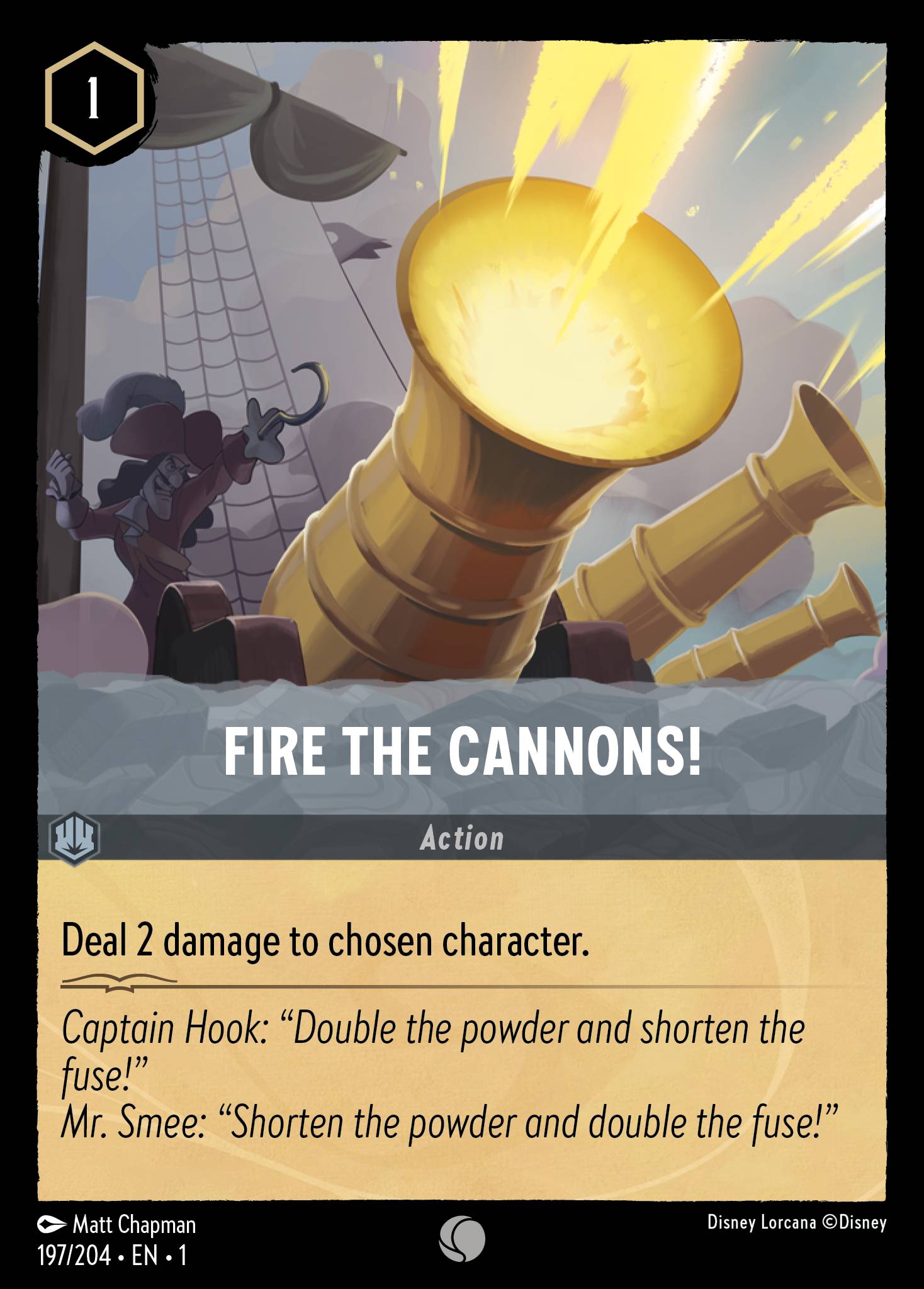 Fire the Cannons!Steel · 1 ink · Action · uninkable
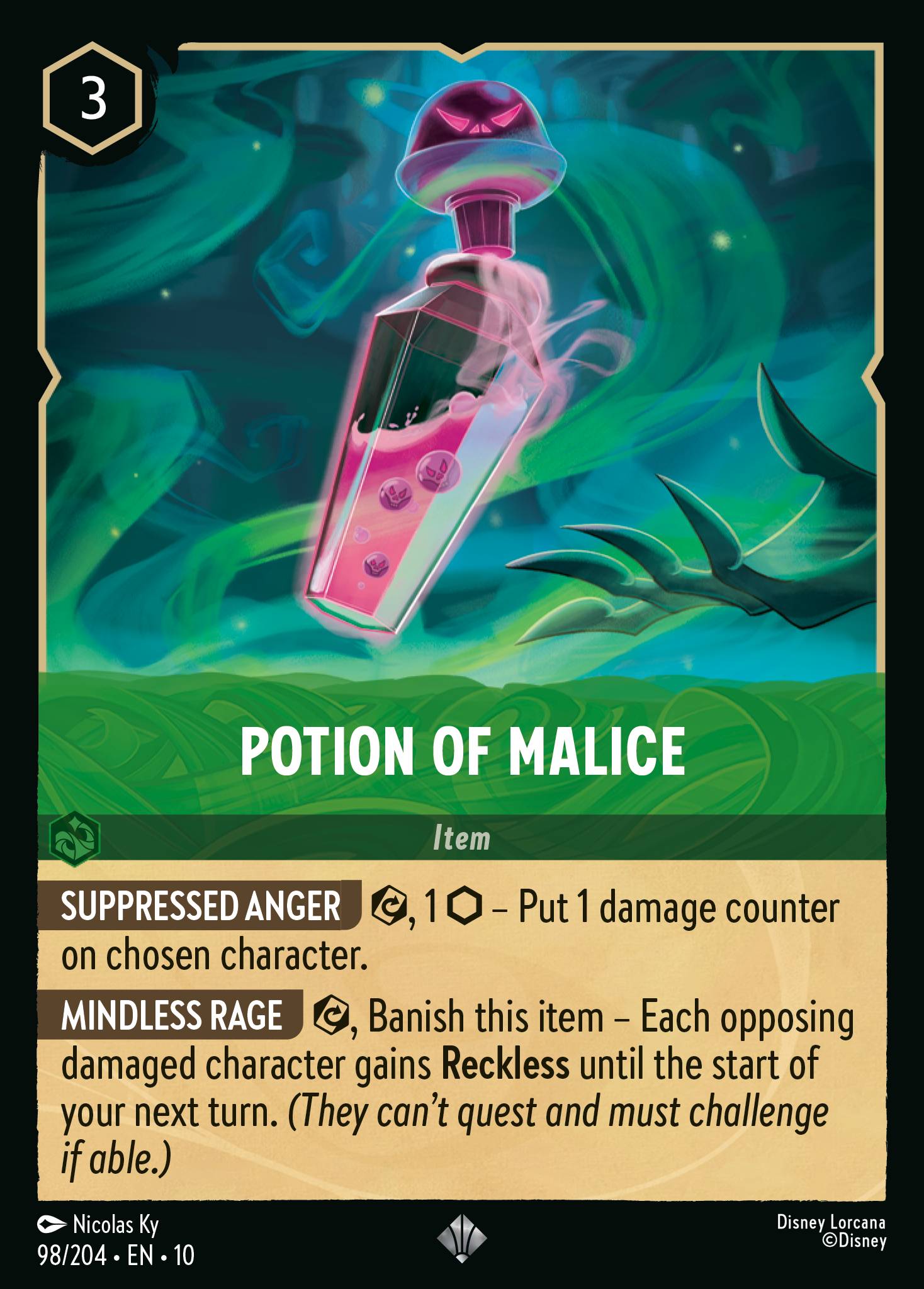 Potion of MaliceEmerald · 3 ink · Item · uninkable
Fire the Cannons! reads "Deal 2 damage to chosen character." Potion of Malice has an activated ability: exert it, pay 1 ink, put 1 damage counter on chosen character. They look like the same tool at different sizes. They are not.
Resist only stops one of them
Resist +N reduces damage that would be dealt to a character (8.8.1). That is the whole scope of the keyword, and one sentence closes the door on the rest.
Damage put or moved onto a character with Resist isn't affected by the ability.
Comprehensive Rules 8.8.3
In plain terms: Resist is armour against challenges and against cards that say deal. It is no protection from a card that puts a counter on you, or moves one onto you.
Run both cards at a character with Resist +2 and 3 Willpower, sitting there clean:
- Fire the Cannons! deals 2 damage. Resist reduces that to 0 and no counter is placed (1.9.4.2, 8.8.2). The card did nothing.
- Potion of Malice puts 1 counter on it. The counter goes on. Resist never came into it.
- Do that three times and the character is banished, having taken every point through a keyword meant to stop damage.
The word on the trigger is the word that matters
The same split runs the other way, on abilities watching for damage rather than causing it.
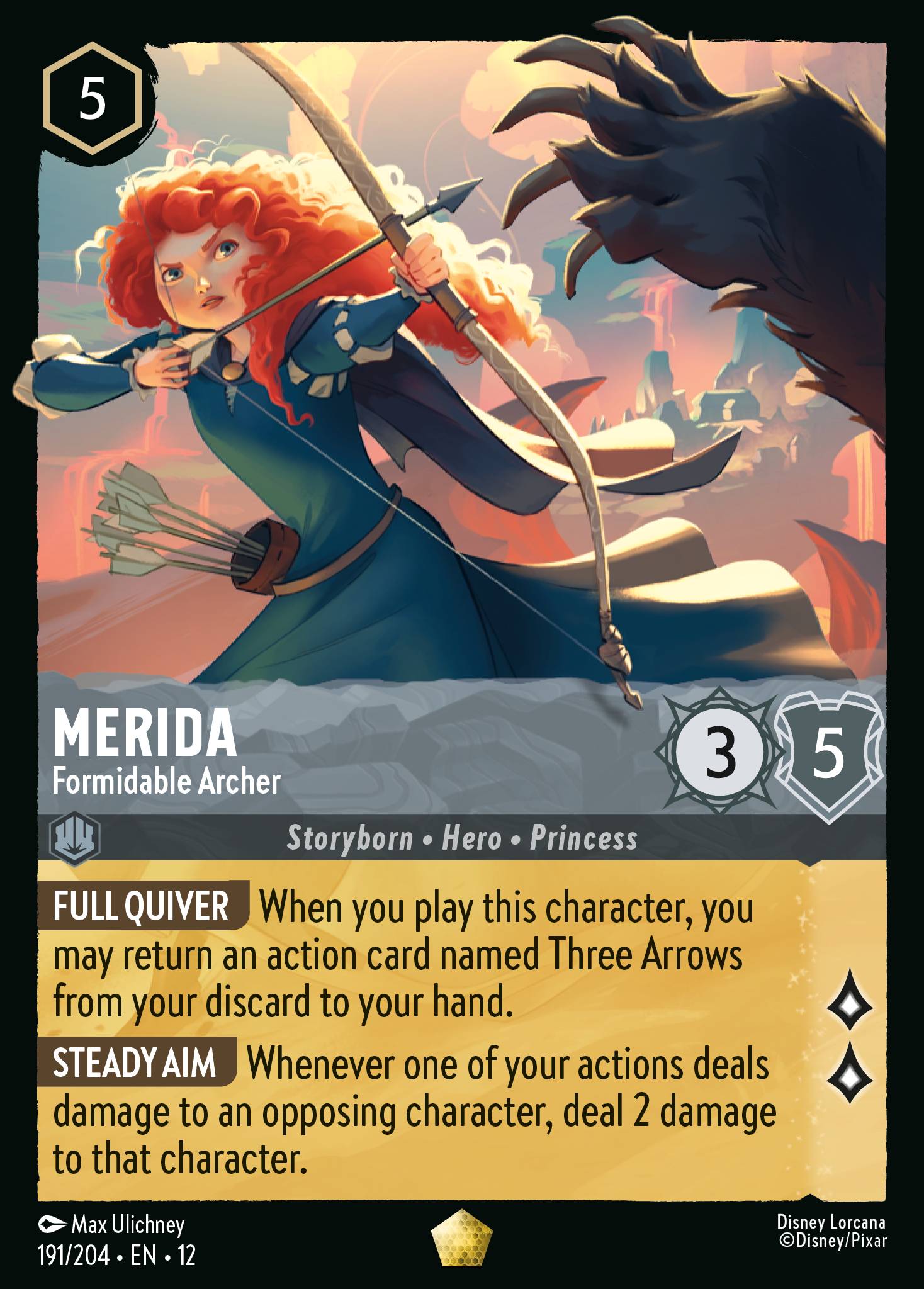 Merida - Formidable ArcherSteel · 5 ink · 3/5 · 2 lore · uninkable
Her Steady Aim ability reads "Whenever one of your actions deals damage to an opposing character, deal 2 damage to that character." An action that puts a counter does not turn it on. Nothing was dealt, so Steady Aim has nothing to see.
It also works in the direction nobody expects. A card can deal damage, have every point of it reduced away, and still count as having dealt damage.
If a character or effect would deal damage and that damage is reduced to 0 when modifiers are applied, the character or effect is still considered to "deal" damage.
Comprehensive Rules 1.9.5
In plain terms: Fire the Cannons! into that Resist +2 character places no counters at all, and Steady Aim triggers anyway. Zero damage dealt is still damage dealt.
One word does cover all four. A character takes damage whenever damage is placed on it by any means (1.9.3), so abilities written around taking damage see every route.
This trap is on defence and it is the expensive one. You have a character with Resist, you read it as hard to remove, and you leave it out in front.
It is hard to remove by challenging. Against a deck built on putting and moving counters it has no defence at all, and it will be banished on a board where you never saw one point of damage dealt to it.
An opposing character has Resist +2 and no damage on it. You play a card reading "Put 1 damage counter on chosen character" and choose it. What happens?
- Nothing. Resist +2 stops the first 2 damage from any source. The common reading, and too generous. Resist reduces damage that would be dealt, and the rules say plainly that damage put or moved onto a Resist character is untouched.
- The counter goes on, and a "whenever one of your actions deals damage" ability you control triggers too. Half right. The counter does go on. But your card put it, and putting is not dealing, so that ability never notices.
- The counter goes on, and no ability watching for dealt damage triggers. Correct on both halves, which are one fact seen from two sides. Put is not deal, so Resist does not reduce it and "deals damage" abilities stay quiet.
How often this actually comes up
Honestly, not every game. Most of the time a counter is a counter and the character is banished at the same moment either way.
It bites in three places: when your opponent has Resist, when either player holds an ability reading "deals damage", and when you meet a new card and your brain supplies the verb you expected instead of the one printed. That last one is why it is worth learning now. It is a reading habit, not a calculation.
- One counter means one damage, however it got there.
- Deal means a challenge or a card saying deal.
- Put and move place counters without dealing any damage.
- Resist reduces damage dealt, and nothing else.
- Damage reduced to 0 still counts as damage dealt.
The next single card you play that touches damage, say its verb out loud before you resolve it. Deal, put, remove or move. One card, not every card.
Rules quoted from the Disney Lorcana Comprehensive Rules, version 2.2.0, effective 9 July 2026. Card text checked against the current card data. We cite rule numbers because they change between versions and a claim without one is a claim you have to take on faith.
Next: The game state check. It is the moment the game stops and looks at all those counters to decide what is banished.
No account needed. Sign in and your progress follows you anywhere.