

Module 2 · Learn the Table · Lesson 1 of 11
What an ability actually is
Two cards can say almost the same thing and behave completely differently, because one waits for you and one does not. There are only four kinds of ability in Lorcana. Once you can name which one you are holding, you stop missing abilities and you stop waiting for ones that already happened.
- The White Rose has a triggered ability. A Wealth of Happiness reads "When you play this character, gain 1 lore." You never decide to use it. Playing the card is what sets it off, and the lore arrives on its own.
- Beast has an activated ability. I've Had It! lists a cost first, then a dash, then what you get. Nothing happens until you choose to pay it, and you can choose not to.
- The dash is the tell. Cost on the left, effect on the right. If you can see that shape in the text box, the ability is waiting for you rather than for the game.
Every ability answers one question: when
The four kinds are triggered, activated, static and keyword. They are not four topics to memorise. They are four answers to a single question.
The kind of an ability tells you who makes it happen, and when. A triggered ability waits for something. An activated ability waits for you. A static ability does not wait at all.
Before the four, the word itself. An ability is printed text that changes the game, and it lives in the text box under the art.
An ability is any card text in the text box on a character, item, or location that can affect the game.
Comprehensive Rules 6.1.1
In plain terms: if it is printed in that box and it does something, it is an ability. One card can carry more than one, usually split by a paragraph break (6.1.1.1).
Actions do not have abilities
Read that rule again and notice what is missing. It names characters, items and locations. It does not name actions.
That is on purpose. An action is an instruction you carry out once and then put in your discard. It never sits in front of you, so it has nothing to wait for and nothing to switch on. The rules say action cards do not have abilities and instead generate effects as they resolve (6.1.1.2).
So when you read an action, there is nothing to classify and nothing to remember later. You do what it says, and it is over.
The four kinds, and how to spot each one
Triggered
Something happens, and the card answers. You can spot one from its first word.
Triggered effects start with "When," "Whenever," "The first time," "The second time," "The next time," "At the start of," or "At the end of" and describe both the game state that causes the abilities to trigger and the effects of the abilities.
Comprehensive Rules 6.2.2
In plain terms: those opening words are the tell. You do not choose to use a triggered ability. Its condition is met, and it goes to a holding area called the bag to be resolved from there (6.2.3). The bag has a lesson of its own later.
Activated
You pay something, you get something. An activated ability is written as a cost, then a long dash, then the effect (6.3.1). Nothing happens unless you decide to do it, on your own turn (6.3.2).
 Elsa - Snow QueenAmethyst · 3 ink · 2/3 · 1 lore · inkable
Elsa above has an activated ability called FREEZE. The cost is exerting her, and the effect is that an opposing character becomes exerted. She does nothing until you spend her.
Static
No trigger, no cost, nothing to announce. A static ability is true the whole time, without anyone doing anything about it.
Static abilities are effects that could alter characteristics of a card, game rule, or game state. These are continuously active for a specific length of time (usually a printed duration).
Comprehensive Rules 6.4.1
In plain terms: it is on the whole time the card is in play, unless the card names a shorter window.
 Jafar - Keeper of SecretsAmethyst · 4 ink · 0/5 · 2 lore · inkable
Jafar has HIDDEN WONDERS, which reads "This character gets +1 Strength for each card in your hand." Draw a card and he is bigger. Play a card and he is smaller. Nobody announces either change, because the counting is redone continuously while the ability is active (6.1.8).
Keyword
One bold word standing in for a whole ability, sometimes with a number after it (6.1.9). The official list is short and closed: Alert, Bodyguard, Boost, Challenger, Evasive, Reckless, Resist, Rush, Shift, Singer, Sing Together, Support, Vanish and Ward (8.1.1). That is 14 words, and there are no others.
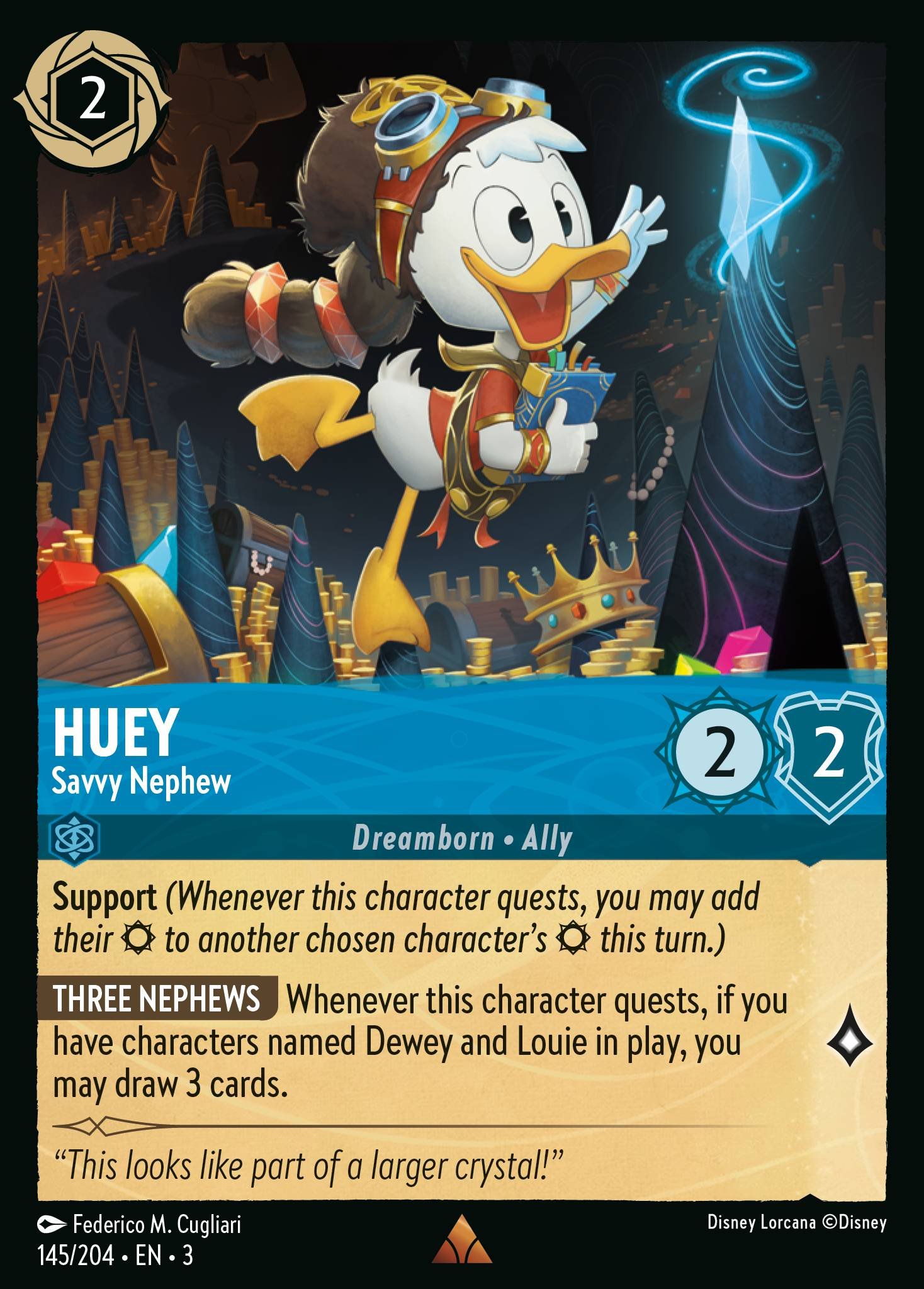 Huey - Savvy NephewSapphire · 2 ink · 2/2 · 1 lore · inkable
Huey is a good card to look at, because he carries two abilities of two different kinds. Support is a keyword. THREE NEPHEWS underneath it opens with "Whenever," so it is triggered.
The mix is lopsided. Count each card name once among cards legal in Core, and 460 of 1,026 names carry a triggered ability. Keywords are on 285, static abilities on 268, and activated abilities on only 99. A further 167 names have no ability text at all, and a card with two kinds is counted twice.
The italic words in brackets are not the rules
Under a keyword you will usually find a sentence in italics inside round brackets. It looks like rules text. It is not.
Some cards include reminder text set in italics and within parentheses. Reminder text isn't rules text. It's only a memory aid and may vary without changing the meaning of the rules on any given card.
Comprehensive Rules 1.1.7
In plain terms: it is a note to help you remember. Two cards with the same keyword can word it differently, and neither wording is more correct. Read it, use it, and never settle a disagreement with it. The rules for a keyword live in the rules (8.1.1).
You play a character, see an activated ability, and reach straight for it. Most of the time you cannot have it.
If the cost includes exerting that character, the character has to be dry, which means it was already in play when your turn began (6.3.1.1). If the cost is only ink, you may use it the turn you play it. An item or a location can use its activated ability the turn it comes down (6.3.1.2), which is a real reason to play one early.
A character's text box reads: "While you have an item in play, this character gets +1 Strength." What do you have to do to use it?
- Exert the character. That is the shape of an activated ability: a cost, a long dash, then the effect. This line has no cost and no dash, so there is nothing to pay.
- Nothing. It is on by itself whenever you have an item in play. Correct. This is a static ability, continuously active while its condition is true. The moment the item leaves play the bonus is gone, and nobody announces either change.
- Wait for it to be triggered by something. A triggered ability opens with When, Whenever, At the start of, or a similar phrase. This one opens with While, which sets a condition rather than a moment.
Where the four kinds stop helping
Naming the kind tells you when an ability happens. It does not tell you what it does, and it certainly does not tell you whether the card is any good.
The edges blur too. A triggered ability can hand you a static effect. Take a card reading "when you play this character, all characters get -3 Strength until the start of your next turn." That fires once as a trigger, then leaves an effect running until a stated moment (6.4.2.2). It sits in two boxes at once, and that is normal rather than a fault in the system.
- Four kinds: triggered, activated, static, keyword.
- Triggered abilities open with When, Whenever, At the start of.
- Activated abilities show a cost, a long dash, then the effect.
- Static abilities are on by themselves, with nothing to announce.
- Italic text in brackets is a memory aid, not rules.
Take 5 cards and say the kind of each ability out loud. Only the kind, not what it does. Five cards, once, and then stop.
If you own no cards yet, do it with the first 5 you are ever dealt.
Rules quoted from the Disney Lorcana Comprehensive Rules, version 2.2.0, effective 9 July 2026. The ability counts come from our own card database on 9 August 2026, counting each card name once among cards legal in Core.
Next: Choosing and chosen. Most of the abilities you can now name end by asking you to choose something, and that one word carries rules of its own.
No account needed. Sign in and your progress follows you anywhere.